Upa gurumandal where उप (upa) meaning subordinate, गुरु (guru) — spiritual mentor, मण्डल (maṇḍala) assembly. The Pratyaksha Mahasiddhas where प्रत्यक्ष (pratyakṣa) meaning Directly perceived, also known as the Upa Gurumandal, are a council of living Mahasiddhas entrusted with preserving and transmitting the Siddha Dharma tradition. They safeguard its teachings through both written scriptures and an extensive oral tradition, much of which has been passed down directly from guru to disciple over generations.
The members of the Upa Gurumandal are not regarded as ordinary individuals. According to the Siddha Dharma tradition, they lead extraordinary spiritual lives dedicated to the protection, practice, and continuation of the lineage.
These Mahasiddhas do not impart their complete spiritual knowledge to the general public. Instead, they transmit the highest teachings only to a carefully chosen disciple who has undergone rigorous testing and has been recognized as spiritually worthy. Such a disciple is identified in the Siddha Dharma tradition as an Achala Rakshak or Achala Bhairava and is entrusted with preserving and carrying the lineage forward.
The number of Mahasiddhas in the Upa Gurumandal is not fixed and varies from one period to another according to the needs of the tradition. At present, the Upa Gurumandal consists of thirty-eight Mahasiddhas.
Within the Siddha Dharma tradition, the members of the Upa Gurumandal are regarded as spiritually free and fully accomplished masters. Although each is autonomous in spiritual attainment, they collectively acknowledge only the authority of the Kulant Nath (Kaulantak Nath), the supreme spiritual head of the Siddha Dharma lineage.
Each member of this council is regarded as a master of a distinct branch of spiritual knowledge and practice within the Siddha Dharma lineage.
Mahasiddha Ishaputra was nominated to become the Kaulantak Nath, the supreme spiritual authority of Siddha Dharma, and to assume the esoteric title of 'Guhya Shikhi Rudra' (Bhairava). To prepare him for these responsibilities, every guru of the Upa Gurumandal imparted specialized teachings, initiations, disciplines, and practical training in their respective fields of mastery.
The training was not limited to instruction alone. The gurus subjected Mahasiddha Ishaputra to comprehensive examinations on multiple spiritual, philosophical, yogic, tantric, and practical levels to assess his knowledge, realization, discipline, and eligibility. Only after successfully completing these examinations was he formally recognized as Kaulantak Nath.
38 Gurus of Mahasiddha Ishaputra
According to the Siddha Dharma tradition, Balak Mahasiddha Satyendra Nath Ji was born in the village of Larji in the present-day state of Himachal Pradesh, India. Soon after his birth, Mahasiddha Siddha Siddhant Nath Ji, the then Kulant Nath (Kaulantak Nath) and Kaulantak Peethadheeshwar, visited his family. Upon seeing the child, he recognized certain auspicious spiritual characteristics (lakshanas) and declared that the boy was destined to become his disciple and receive the highest knowledge of the Siddha Dharma tradition.
Initially, Mahasiddha Satyendra Ji’s parents were unwilling to send their son to be trained in the lineage. Despite their refusal, Mahasiddha Siddha Siddhant Nath Ji continued to visit the family over the following years, patiently attempting to convince them of the child’s spiritual destiny.
When Mahasiddha Satyendra Nath Ji reached the age of three, Mahasiddha Siddha Siddhant Nath Ji again approached his parents. He assured them that he was not taking the child away permanently. Mahasiddha Satyendra Nath Ji would continue to live with his family and would only travel to the Himalayas from time to time to receive spiritual education, initiations (deekshas), and training in Siddha Dharma. Reassured by this promise, his parents finally consented.
Mahasiddha Siddha Siddhant Nath Ji then declared that Mahasiddha Satyendra Nath Ji’s first initiation should take place on Paush Krishna Paksha Panchami, Vikram Samvat 2042, under the Purva Phalguni Nakshatra. According to the customs of the lineage, this initiation could not be performed inside a house; it was required to be conducted either in the mountains or on the banks of a river.
Since the rivers in the region were swift and dangerous, and Mahasiddha Satyendra Nath Ji was still a young child, his father was reluctant to hold the ceremony beside the river. Instead, he offered a piece of his land situated a short distance from Larji on the route towards the Sainj Valley. The land was covered with numerous plum trees and provided a suitable natural setting. He also arranged accommodation for Mahasiddha Siddha Siddhant Nath Ji, who accepted the proposal.
Accordingly, on Paush Krishna Paksha Panchami, Vikram Samvat 2042, under the Purva Phalguni Nakshatra, the initiation ceremony was performed at that sacred location. During this ceremony, the child received his first Deeksha into the Siddha Dharma lineage and was bestowed with the spiritual name Mahasiddha Satyendra Nath Ji.
At approximately six years of age, Mahasiddha Satyendra Nath Ji was taken to the higher Himalayas for the first time to receive further initiations and advanced spiritual education. The harsh Himalayan environment posed significant challenges for a child of his age, making survival and training extremely demanding.
During this period, he met his second guru, Mahasiddha Isha Nath Ji. According to the tradition, Isha Nath Ji cared for the young disciple with exceptional affection and compassion, nurturing him with the same tenderness as a mother. As a result, Satyendra Nath developed an especially deep bond with Isha Nath Ji, a relationship that remained unique among all his gurus.
When Mahasiddha Satyendra Nath Ji reached approximately ten years of age, it was decided that he should receive the complete body of Siddha Dharma knowledge from the various masters of the tradition. To accomplish this, the other Mahasiddhas of the Upa Gurumandal were invited to impart their respective disciplines, initiations, and specialized teachings.
A suitable location for this extensive training was then sought. Eventually, nine secluded and highly secret places were identified in the Himalayan region. During that period, these sites remained isolated and were seldom visited by ordinary people, providing an ideal environment for advanced spiritual instruction.
One of these nine sacred locations is the site where the Gurumandal Temple stands today.
Over the following years, Mahasiddha Satyendra Nath Ji received his education, initiations, and training by moving from one of these sacred places to another. Under the guidance of the 38 Mahasiddhas from the Upa Gurumandal, he studied the 38 diverse streams of Siddha Dharma, preparing himself for the responsibilities he would later assume as Kaulantak Nath.
In the Siddha Dharma tradition, whenever a disciple receives spiritual knowledge from a Guru, the Guru bestows upon the disciple a sacred name according to the lineage or stream (paramparā) to which the Guru belongs. Consequently, as Masiddha Satyendra Nath received initiation and knowledge from 38 Gurus, each belonging to a distinct spiritual stream, he was bestowed with 38 different sacred names.
| SL No. | Name of 38 Mahasiddhas | Image of Mahasiddhas | Name Given to Mahāsiddha Īśaputra |
|---|---|---|---|
| 1 | Mahāsiddha Siddha Siddhānta Nātha महासिद्ध सिद्ध सिद्धान्त नाथ | Satyendra सत्येन्द्र | |
| 2 | Mahāsiddha Karāla Nātha महासिद्ध कराल नाथ | Cittasarga चित्तसर्ग | |
| 3 | mahāsiddhā Smṛti Nātha महासिद्धा स्मृति नाथ | Sujohā सुजोहा | |
| 4 | Mahāsiddha Mukti Nātha महासिद्ध मुक्ति नाथ | brahmaghaṭa ब्रह्मघट | |
| 5 | Mahāsiddha Dakṣiṇa Nātha महासिद्ध दक्षिण नाथ | Graharāja ग्रहराज | |
| 6 | Mahāsiddha Divya Deva Nātha महासिद्ध दिव्य देव नाथ | Muktapāṇi मुक्तपाणि | |
| 7 | Mahāsiddha Vāma Nātha महासिद्ध वाम नाथ | Mahānātha महानाथ | |
| 8 | Mahāsiddha Abhaya Nātha महासिद्ध अभय नाथ | Acalatri अचलअत्रि | |
| 9 | Mahāsiddha Pāṇi Nātha महासिद्ध पाणि नाथ | Devaśira देवशिर | |
| 10 | Mahāsiddha Śyāma Nātha महासिद्ध श्याम नाथ | Vajrāyu वज्रायु | |
| 11 | Mahāsiddha Digambarī Nātha महासिद्ध दिगम्बरी नाथ | Ṛtambhara ऋतंभर | |
| 12 | mahāsiddhā Karṇikā Nātha महासिद्धा कर्णिका नाथ | Amoghāṃśa अमोघांश | |
| 13 | Mahāsiddha Bhayānaka Nātha महासिद्ध भयानक नाथ | Kulavikrama कुलविक्रम | |
| 14 | Mahāsiddha Kṛtaka Nātha महासिद्ध कृतक नाथ | Hiraṇyavāyu हिरण्यवायु | |
| 15 | Mahāsiddha Mahārudra Nātha महासिद्ध महारुद्र नाथ | Mahimañjula महिमञ्जुल | |
| 16 | Mahāsiddha Brahmāṇḍa Maṇḍala Nātha महासिद्ध ब्रह्माण्ड मण्डल नाथ | Nirañjana निरञ्जन | |
| 17 | Mahāsiddha Vyāpaka Nātha महासिद्ध व्यापक नाथ | Mithuneśa मिथुनेश | |
| 18 | Mahāsiddha Svarūpa Nātha महासिद्ध स्वरूप नाथ | Puṇyamitra पुण्यमित्र | |
| 19 | Mahāsiddha Hṛdaya Nātha महासिद्ध हृदय नाथ | Asaṅga Chetana असङ्ग चेतन | |
| 20 | Mahāsiddha Rati Nātha महासिद्ध रती नाथ | Dharmavyāghra धर्मव्याघ्र | |
| 21 | Mahāsiddha Prasanna Nātha महासिद्ध प्रसन्न नाथ | Nirvikalpa निर्विकल्प | |
| 22 | Mahāsiddhā Kālīmathi Nātha महासिद्धा कालीमथि नाथ | Nirlimpa निर्लिम्प | |
| 23 | Mahāsiddha Sarva Nātha महासिद्ध सर्व नाथ | Sarva सर्व | |
| 24 | Mahāsiddha Nitya Nātha महासिद्ध नित्य नाथ | Śāśvata शाश्वत | |
| 25 | Mahāsiddha Maheśa Nātha महासिद्ध महेश नाथ | Siddhāṃśa सिद्धांश | |
| 26 | Mahāsiddha Candra Nātha महासिद्ध चन्द्र नाथ | Śailarudra शैलरुद्र | |
| 27 | Mahāsiddha Ratna Nātha महासिद्ध रत्न नाथ | jñānātula ज्ञानातुल | |
| 28 | Mahāsiddha Ujjvala Nātha महासिद्ध उज्ज्वल नाथ | Manurpāla मनुर्पाल | |
| 29 | Mahāsiddha Īśa Nātha महासिद्ध ईश नाथ | Īśaputra ईशपुत्र | |
| 30 | Mahāsiddha Padma Nātha महासिद्ध पद्म नाथ | Devabhūṣaṇa देवभूषण | |
| 31 | Mahāsiddhā Mahīdharī Nātha महासिद्धा महीधरी नाथ | Chetanadvīpa चेतनद्वीप | |
| 32 | Mahāsiddhā Ahomā Nātha महासिद्धा अहोमा नाथ | Vyomadhṛk व्योमधृक् | |
| 33 | Mahāsiddha Savita Nātha महासिद्ध सवित नाथ | Anurāṃśa अनुरांश | |
| 34 | Mahāsiddha Samudra Nātha महासिद्ध समुद्र नाथ | Cakracandra चक्रचन्द्र | |
| 35 | Mahāsiddha Bodha Nātha महासिद्ध बोध नाथ | Amṛtapada अमृतपद | |
| 36 | Mahāsiddha Trilocana Nātha महासिद्ध त्रिलोचन नाथ | Hetu हेतु | |
| 37 | Mahāsiddha Prakhara Nātha महासिद्ध प्रखर नाथ | kalpaparṇa कल्पपर्ण | |
| 38 | Mahāsiddha Amitābha Nātha महासिद्ध अमिताभ नाथ | Taḍitaromā तडितरोमा |
The Guru Mandala and the Spiritual Education of Mahasiddha Satyendra Nath Ji
According to the Siddha Dharma tradition, whenever a great Siddha or spiritually accomplished being is born, the child does not initially possess the awareness or knowledge of who he truly is. It is therefore the responsibility of the Guru to identify such a child, bring him into the Siddha tradition, and provide him with the appropriate education and initiation.
Traditionally, it is believed that Kaulantak Nath Himself comes to receive such a child. Until the child reaches a certain age, Kaulantak Nath personally oversees his education and initiation. During this early period, the child is taught Siddha Charya—the complete way of life followed by Siddhas. This includes how a Siddha lives, eats, sleeps, bathes, conducts himself, performs his daily practices, and organizes his entire day. In other words, the child is gradually introduced not merely to spiritual practices but to the complete discipline and way of life of the Siddha tradition.
The same process took place in the case of Balak Mahasiddha Satyendra Nath Ji. At that time, the Kaulantak Nath was Mahasiddha Siddha Siddhant Nath Ji, who personally took Balak Mahasiddha Satyendra Nath Ji under his guidance while he was still a child. He imparted to him the knowledge of Siddha Charya and personally trained him in its practice.
When the child reaches approximately nine years of age, the Kaulantak Nath determines whether the child requires further training from additional Gurus. For this purpose, a gathering of the Upa Gurumandal—the assembly of Mahasiddhas who form part of the broader Guru Mandala—is held. The Mahasiddhas meet with Kaulantak Nath and assess the requirements of the young disciple. Kaulantak Nath then determines how many additional Gurus will be required for the child’s education and training. The selected Gurus subsequently undertake the responsibility of imparting the different branches of knowledge and practice required by the disciple.
The Four Guru Brothers
Mahasiddha Satyendra Nath Ji was one of four Guru brothers - mahasiddha shambhar nath ji, mahasiddha pragalbh nath ji and mahasiddha kirit nath ji who underwent this process of education and training together. Their education was conducted under the guidance of the various Gurus of the Upa Gurumandal.
During the course of their training, two of the four Guru brothers were eventually disqualified from consideration for the position of Kaulantak Nath. This ultimately left two candidates: Mahasiddha Satyendra Nath Ji and his eldest Guru brother, Mahasiddha Shambhar Nath Ji.
Mahasiddha Shambhar Nath Ji was an exceptionally accomplished Siddha. However, he had a serious addiction that adversely affected his health. Over time, his physical condition continued to deteriorate as a consequence of this habit.
At one stage, both Mahasiddha Satyendra Nath Ji and Shambhar Nath Ji went to Mahasiddha Kalimathi Nath Ji to receive further education and initiation in certain advanced practices. Although Shambhar Nath Ji was regarded as one of Mahasiddha Kalimathi Nath Ji’s favourite disciples, he was unable to successfully complete the required practices because of his declining health and the consequences of his addiction.
Within the Guru tradition, it is understood that a Guru may have a particular disciple who is especially dear to him. Such a relationship is based upon the disciple’s qualities, dedication, receptivity, and spiritual potential. In the same way, Mahasiddha Isha Nath Ji regarded Mahasiddha Satyendra Nath Ji as one of his favourite disciples.
During the period in which the disciples were receiving education from the Upa Gurumandal, they were not permitted to question the Gurus whenever they wished. The opportunity to ask questions was given only at specific times, according to the Guru’s discretion. A Guru might permit questions approximately once a month or at whatever interval he considered appropriate.
Mahasiddha Isha Nath Ji played a particularly important role in this aspect of Mahasiddha Satyendra Nath Ji’s education. Whenever Mahasiddha Satyendra Nath Ji was permitted to ask questions, Isha Nath Ji would answer his doubts and help him understand difficult aspects of his training. He also clarified questions relating to the teachings and traditions of the other Gurus.
One of the most important teachings that Isha Nath Ji imparted to Mahasiddha Satyendra Nath Ji was the importance of winning the affection and trust of all the Gurus.
He taught Mahasiddha Satyendra Nath Ji that merely acquiring knowledge from a Guru was not sufficient. A disciple must also learn how to serve the Guru with humility, devotion, discipline, and sincerity. Isha Nath Ji therefore taught him various traditional methods through which a disciple could express reverence and devotion toward the Guru, including Charan Puja, Guru Stuti, Guru Seva, and many other forms of service.
As a result, Guru Seva became an integral part of Mahasiddha Satyendra Nath Ji’s life from a very young age. He would serve the Gurus for long periods, sometimes remaining awake throughout the night to massage their feet and attend to their needs. Through this continuous service, he gradually acquired not only knowledge of the teachings but also a deep understanding of the discipline, humility, devotion, and responsibilities expected of a disciple.
As the education and training of the four Guru brothers progressed, the process of selection for the position of Kaulantak Nath gradually became more defined.
Two of the original four candidates had already been disqualified during the course of their training. The final consideration therefore came down to Mahasiddha Satyendra Nath Ji and Mahasiddha Shambhar Nath Ji.
Although Shambhar Nath Ji was an accomplished Mahasiddha and had been particularly favoured by Mahasiddha Kalimathi Nath Ji, his deteriorating health and other circumstances ultimately prevented him from remaining eligible for the position.
Consequently, Mahasiddha Satyendra Nath Ji emerged as the final candidate and was ultimately appointed as Kaulantak Nath.
The Gurumandal Temple
When Mahasiddha Satyendra Nath Ji was eleven years old, the other four Guru bhai were considerably older. Pragalbh Nath Ji was 32 years old, Kirit Nath Ji was 46, and Shambhar Nath Ji was 67 years old.
Because of this considerable difference in age and experience, the Gurus were initially uncertain about whether a young child like Mahasiddha Satyendra Nath Ji would be capable of undertaking the demanding education and training of the Siddha tradition.
At that time, Mahasiddha Isha Nath Ji spoke in support of Mahasiddha Satyendra Nath Ji. He assured the other Gurus that the child possessed the necessary ability and potential and would be capable of completing the training.
Isha Nath Ji also reminded the assembled Gurus of the various prophecies and traditional predictions that had previously been made within Siddha Dharma concerning the arrival of a child who would attain the position of Kaulantak Nath at a remarkably young age. He reminded them of the characteristics and signs that had been described in those earlier prophecies and explained that Mahasiddha Satyendra Nath Ji displayed those very qualities.
The Gurus subsequently accepted Mahasiddha Satyendra Nath Ji and began imparting knowledge and initiation to him. As his training progressed, Mahasiddha Satyendra Nath Ji continued to demonstrate remarkable ability and steadily excelled in the various disciplines taught to him. Witnessing his progress firsthand, the Gurus gradually developed greater confidence in his potential. They therefore intensified his training and devoted increasing effort to his education and initiation.
Within approximately two years of this training, two of Mahsiddha Satyendra Nath Ji’s Guru brothers—Pragalbh Nath Ji and Kirit Nath Ji—were disqualified from the process. The Guru Mandala then concentrated its efforts primarily on the two remaining candidates, Mahasiddha Satyendra Nath Ji and Mahasiddha Shambhar Nath Ji.
The Guru Murtis
Mahasiddha Isha Nath Ji had taught Mahasiddha Satyendra Nath Ji various methods through which a disciple could show reverence toward and please his Gurus. One of the practices that developed from this teaching was Mahasiddha Satyendra Nath Ji’s deep devotion toward all his Gurus.
Following this tradition, Mahasiddha Satyendra Nath Ji had stone statues made of his Gurus. These Guru Murtis are preserved today in the Gurumandal Temple.
During the period when the Gurus were physically present and available to him, Mahasiddha Satyendra Nath Ji would worship and serve them directly. When a particular Guru was not physically present, he would sit before that Guru’s idol and continue to practice and revise the teachings and initiations that he had received from that Guru.
In this way, the Guru Murtis became more than representations of the Gurus. They served as a means through which Mahasiddha Satyendra Nath Ji maintained his discipline, remembrance, practice, and connection with the teachings of his Guru Mandala even in the physical absence of the Gurus.
The present-day Gurumandal Temple therefore preserves not only the stone images of the Gurus but also a living reminder of the system of Guru Seva, Guru Smarana, education, practice, and transmission of knowledge through which Mahasiddha Satyendra Nath Ji was trained.
The Origins of the Gurumandal Temple
The Gurumandal Temple is situated in the place called shaul Kandha located in the mountain opposite to the jogini Kandha mountain.
The history of this sacred place is closely connected with the childhood of Mahasiddha Ishaputra and the circumstances surrounding his early spiritual education.
During his childhood, Ishaputra was repeatedly prevented by his family from undertaking yogic practices and spiritual sadhana. Ishaputra was born into a Kshatriya (Rajput) family, and his family did not want anyone in their lineage to become a yogi or Sadhu. They wanted him to follow what they considered the conventional path of family and social life.
Ishaputra’s grandfather had two younger brothers. The youngest of the three is still alive. Ishaputra’s grandfather himself had passed away long before Ishaputra was born.
It was the middle grandfather—the grandfather’s younger brother—who owned the land in the Jogini Kandha mountain on which the Gurumandal Temple stands today. The land originally measured approximately eight bighas. He had two sons, and the property was subsequently divided equally between them, with approximately four bighas going to each son.
Despite being stopped from practising at home, Ishaputra’s inclination towards yoga and sadhana was so strong that he would sometimes secretly leave the house and go down into the valley beneath the mountains.
There was a small cave in that area. Although the cave itself was very small, for a child as young as Ishaputra, it was large enough to serve as a place of solitude and practice. He would go there alone and perform his yogic practices and sadhana away from the eyes of his family.
There was, however, a serious danger associated with this place. The area where Ishaputra used to go was known to have a large population of leopards. For such a young child to wander alone in that region was extremely dangerous, and the possibility of encountering a leopard made his secret journeys particularly risky.
His grandfather eventually became aware that Ishaputra would secretly leave the house and disappear into the mountains. He told him that although they did not know exactly where he went or where he hid himself, they knew that the area he was visiting was inhabited by many leopards and that it was therefore extremely dangerous for a young child to go there alone. Also One day, Ishaputra’s grandfather witnessed an incident at the family’s old house in Balichowki. Ishaputra was being beaten by his father because he repeatedly went away to meet and learn from his Sadhu and Siddha Gurus rather than following the conventional life that his family expected of him.
Seeing this, his grandfather asked him what he actually wanted.
Ishaputra replied that he wanted to acquire all the knowledge that his Gurus wished to impart to him. However, he explained that his family would not allow him to go to his Gurus freely. Moreover, he had very limited opportunities to spend time with them because his Gurus lived high in the Himalayas, and once winter arrived, travelling to those high-altitude regions became extremely difficult or even impossible.
Due to these reasons His grandfather then offered him a solution.
He told Ishaputra that he owned a piece of land in the shaul kandha place, relatively close to the village. A simple shed had been constructed there for keeping cows and storing grass and fodder.
He suggested that Ishaputra could request his Gurus to come to this place and teach him instead. This would solve both problems: Ishaputra would no longer have to undertake dangerous journeys into the leopard-inhabited valley, and he would not have to repeatedly travel to the high Himalayas to meet his Gurus.
Since the place was close to the village, Ishaputra could visit it whenever necessary, while his Gurus could also come there and stay with him for the purpose of his education and spiritual training.
Ishaputra followed his grandfather’s suggestion.
His Gurus began coming to the site, where they would stay and impart teachings, initiations, and spiritual training to him. During their stay, Ishaputra’s grandfather took responsibility for providing food and attending to the other necessities of the Gurus.
Thus, what had originally been a simple piece of family land with a shed for cattle and fodder gradually became an important place of Guru-Shishya education and spiritual transmission in Ishaputra’s childhood.
Following the division of the ancestral property between the two sons, the portion containing this land was allotted to the younger son.
In later years, the Peeth acquired the land again, bringing the sacred site back under the institution associated with Ishaputra’s spiritual tradition.
The place that had once served as a simple shelter where Ishaputra’s Gurus could stay and teach him eventually became the site of the Gurumandal Temple.
The Gurumandal and the Kurukulla Temple
The Kurukulla Temple is one of the nine sacred sites associated with the Guru Mandala and the spiritual journey of Mahasiddha Ishaputra.
In earlier times, before the present-day Kurukulla Temple was constructed, the site was home to a small and ancient temple. The area was largely uninhabited, and very few people travelled to or visited the place. Despite its remote and secluded nature, the site held great significance within Ishaputra’s spiritual journey.
Several of Ishaputra’s Gurus visited this sacred place and imparted Deeksha to him there. Unlike the Gurumandal Temple at Jogini Kandha, where a substantial part of Ishaputra’s formal education and spiritual training took place, the Kurukulla site was primarily associated with initiation and transmission of specific spiritual traditions. Most of the Deekshas received by Ishaputra at this location took place there, while his principal education and systematic training were conducted at the Gurumandal Temple.
The Kurukulla Temple holds particular significance because it was here that His Holiness Mahasiddha Siddhant Nath Ji, who was Ishaputra’s Guru and the Kaulantak Nath of that period, bestowed upon him the four traditional Piṇḍīs of Siddha Dharma:
- Bhagwati Sukulla
- Bhagwati Kurukulla
- Bhagwati Vikulla
- Swachchhanda Bhairava
These four Piṇḍīs represent an important component of the traditional spiritual inheritance transmitted within Siddha Dharma.
Thus, the Kurukulla Temple occupies a distinct place among the sacred sites associated with the Guru Mandala. While the Gurumandal Temple is primarily remembered as a place where Ishaputra received education, training, and sustained Guru-Shishya instruction, Kurukulla Temple is particularly associated with Deeksha and the transmission of important traditional spiritual lineages and practices.
The Ishaputra Temple and the Gurumandal
The Ishaputra Temple is another of the nine sacred sites associated with the Guru Mandala and the spiritual journey of His Holiness Mahasiddha Ishaputra.
This site holds particular significance because two of Ishaputra’s principal Gurus, His Holiness Mahasiddha Siddhant Nath Ji and His Holiness Mahasiddha Isha Nath Ji, would come to this place to impart knowledge and spiritual teachings to him.
The site is also associated with Lazeram Gur Ji, who was the Guru of Bhagwati Totla. According to the tradition, Lazeram Gur Ji also received teachings and knowledge at this sacred location.
Because of its association with these accomplished Gurus and the transmission of spiritual knowledge that took place there, the Ishaputra Temple is regarded as an important site within the broader sacred geography of the Guru Mandala.
Gurus of Mahasiddha Ishaputra
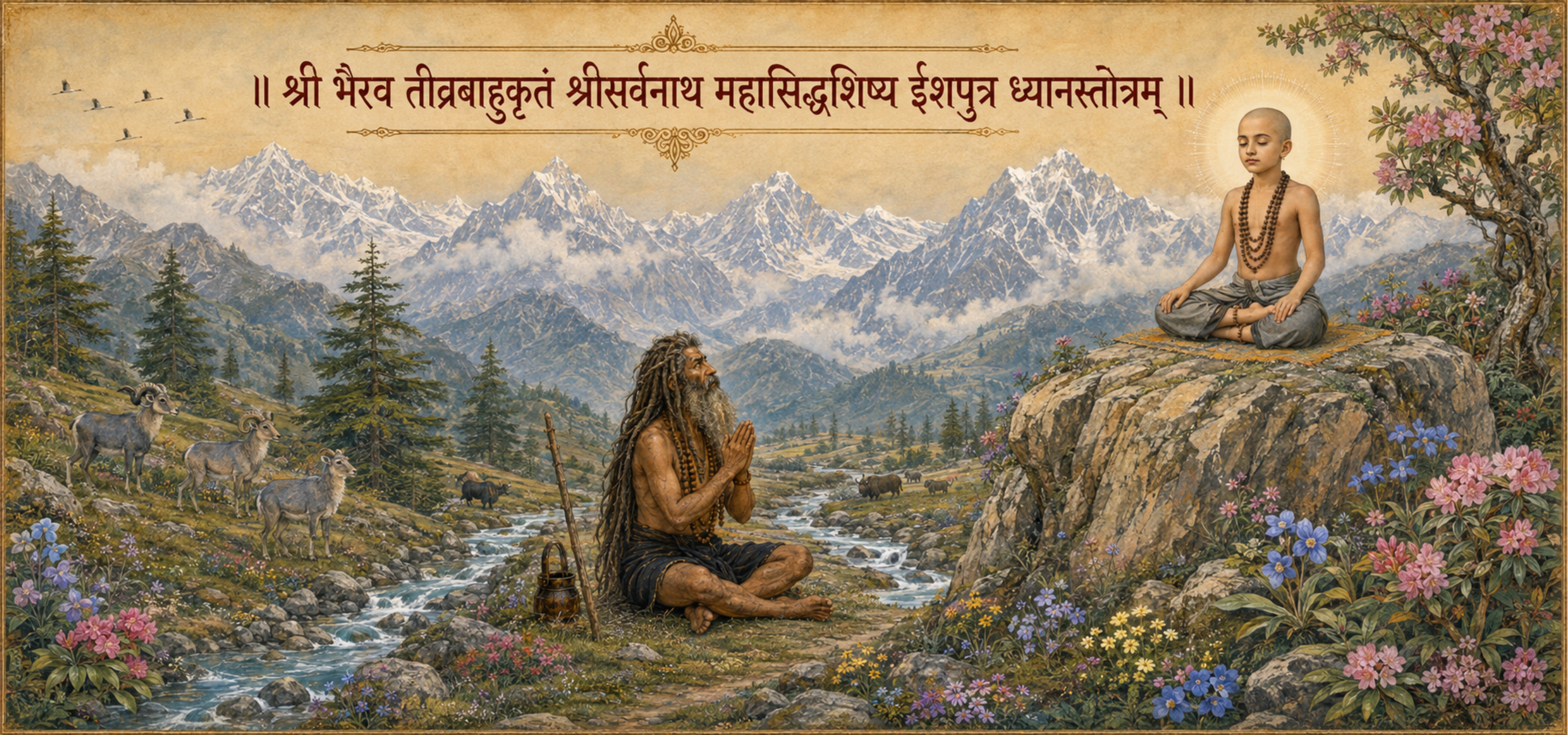
Ishaputra Naam dhyana Stuti by his first disciple - Teevrabahu
Teevrabahu was among the earliest disciples of Mahasiddha Ishaputra. However, he did not receive any formal Deeksha from Ishaputra. Teevrabahu was an accomplished practitioner of Gheranda Yoga and spent much of his life travelling through the Himalayan regions, including Himachal Pradesh, Uttarakhand, and Nepal, in pursuit of spiritual practice and knowledge.
According to the traditional account, through the influence of his accumulated karmas, Teevrabahu eventually came into contact with Mahasiddha Isha Nath Ji. During this period, he observed that Isha Nath Ji had accepted Ishaputra as his disciple and was personally guiding and educating him.
When Teevrabahu learned that a group of 38 Gurus was preparing Ishaputra for his future spiritual responsibilities, he developed deep reverence for him and began regarding Ishaputra as his Guru.
From that point onward, Teevrabahu closely followed Ishaputra's life and spiritual journey. He sought to learn as much as possible about his Gurus, his education, his practices, and the various stages of his spiritual development.
Teevrabahu had a particular interest in Sanskrit and subsequently composed several writings in Sanskrit concerning Mahasiddha Ishaputra and his spiritual journey.
Among the earliest works he composed was an account describing the Gurus of Mahasiddha Ishaputra, the names and designations bestowed upon Ishaputra by his various Gurus, and the influence and significance of those names in his spiritual journey.
This work was composed in the form of a Dhyāna Stuti, preserving Teevrabahu's understanding and contemplation of Ishaputra and his Guru-paramparā.
It is important to note that Teevrabahu was not a highly accomplished scholar of Sanskrit. Consequently, the original composition contains certain linguistic and grammatical imperfections. Nevertheless, the text has been preserved in its original form without altering or correcting those passages, so that the work remains faithful to the form in which Teevrabahu originally composed it.
The text may be studied and refined further in the future. For the present, its value lies not only in its literary form but also in the fact that it represents an early written account of Mahasiddha Ishaputra, his Gurus, the names given to him by them, and the significance attributed to those names by one of his earliest disciples.